Where AI Companion Money Actually Comes From — and Why the Map Surprises People
2026-07-28 · 7 min read
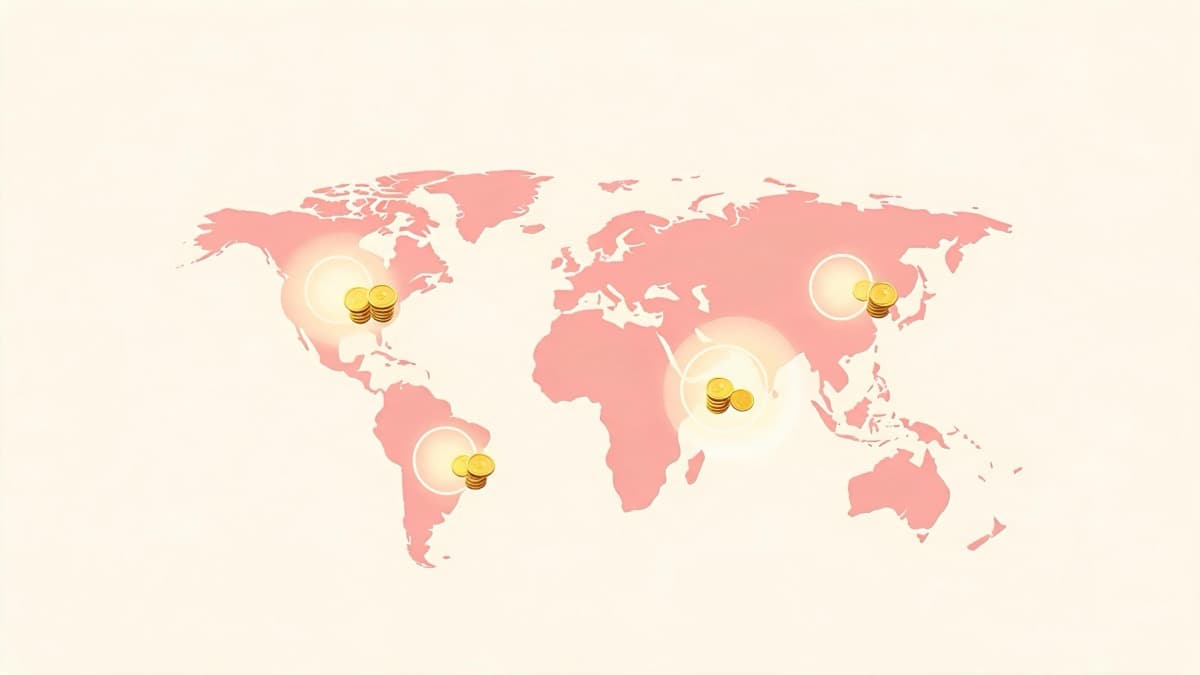
The story everyone tells about AI companions is an American one: lonely men in Western countries paying for AI girlfriends. Nearly every part of that sentence turns out to be wrong, or at least much less true than assumed.
The largest single market is indeed the United States. But the second is India, the third is Brazil, the two highest-grossing apps in the world are South Korean and Singaporean, both are aimed primarily at women — and China is running a parallel market that barely intersects with any of it.
Here's what the geography actually looks like, and why it matters more than the headline market-size numbers.
The spending map
The most recent country-level breakdown published for the category, from Appfigures via Statista and covering January 2023 to December 2024:
United States — over 30% of global consumer spend on AI companion apps. India — over 24%. Brazil — 12.4%. Everything else, including the whole of Europe, splits the remaining third.
India at number two by *spending* is the genuinely surprising figure, and worth holding a little loosely — it runs against the usual assumption that high-volume, lower-ARPU markets drive downloads while the West drives revenue. It may reflect sheer scale plus locally-priced tiers. But it is the published breakdown, and no one has published a better one since.
For a rough cross-check on the direction of travel: for generative-AI mobile purchases overall, the US accounted for around 38% of global revenue between Q2 2025 and Q1 2026. American dominance is real, but it is a plurality, not a monopoly.
The biggest apps aren't American, and aren't for men
When we verified who publishes the top-grossing mobile companion apps, the map got stranger.
The number one earner in the first half of 2026 was Zeta, at $33 million, published by Scatter Lab, Inc. of Seoul. Scatter Lab's own figures put 87% of its roughly 900,000 monthly users in their teens or twenties — and 65% of them are women.
Number two was Tipsy Chat, at $15.2 million, published out of Singapore. Open it and the catalogue is wall-to-wall bishōnen male leads; its single most-used story had 3.4 million chats and opens with the line "What's the matter, pretty girl?"
So the two highest-grossing romantic AI companion apps on earth are East Asian in origin and predominantly female in audience. The English-language conversation about this category — including, until recently, most of this website — has been built around the opposite assumption.
China is a different market entirely
China barely appears in any of the figures above, because it is running its own version of this industry on different rails.
MiniMax's Xingye — and its international sibling Talkie — claims north of 212 million registered users. Its monetisation is primarily advertising, not subscriptions or consumable currency, which is a fundamentally different business from the gem economies that dominate the West. Reported engagement runs around 70 minutes a day. MiniMax listed on the Hong Kong Stock Exchange in January 2026 and closed its first day up 109%.
The content skews the other way too. Where Western coverage fixates on AI girlfriends, Chinese platforms are notable for AI boyfriends — a gender inversion that has been widely observed and that mirrors what we found in Korea and Singapore.
Chinese regulators are drafting rules specifically for AI romantic companions. Whatever emerges will apply to a market most Western analysts aren't counting, which is one more reason to distrust any single global figure.
Why the geography matters commercially
Three consequences fall out of this map.
The category's centre of gravity is not where the coverage is. A market whose biggest products are Korean, Singaporean and Chinese, and whose second-largest spending nation is India, is not well described by journalism written almost entirely about American and European apps.
The audience assumption is load-bearing and wrong. Product decisions, review sites and investment theses built on "lonely men buying AI girlfriends" are mis-specified for the top of the market. The money is substantially female, and substantially young.
No single global number survives it. An app-store figure omits the web platforms. A Western figure omits China's ad-funded giants. A subscription-based estimate omits per-message gem economies entirely. Anyone quoting one confident worldwide total is smoothing over at least three incompatible markets — which is the argument we made at length here.
What we still don't know
The country breakdown above covers 2023–2024. Nobody appears to have published a comparable geographic split for 2025 or 2026, which is frustrating given how much the category has changed in that time — most of its all-time revenue has arrived since.
There is no country-level data at all for the web-billed platforms, which are invisible to app-store intelligence and represent an unknown but substantial share of global spending.
And we have no reliable read on how much of India's and Brazil's spend goes to local apps versus international ones. If you have seen credible data on any of these, we would genuinely like to see it — our sourced figures are collected on the AI Companion Statistics 2026 page.
Next steps
Related reading
The Highest-Grossing AI Companion Apps Aren't the Ones You've Heard Of
Appfigures data puts $162.8M through romantic AI companion apps in H1 2026. We checked every app on the leaderboard, installed the top two, and found one that isn't a companion app at all.
The $2.9 Billion AI Girlfriend Market Doesn't Exist — Here's What People Actually Spend
Analyst forecasts put the AI girlfriend market at $2.9 billion and rising. Observed consumer spending is about a twentieth of that. We traced where the big numbers come from — including one we published ourselves.
AI Companion Statistics 2026: The Data
The numbers behind the AI companion boom — market size, user growth, demographics, loneliness, and the safety record — each with a source.
Sources
- Statista / Appfigures — top markets for AI companion apps
- Decrypt / Appfigures — H1 2026 companion app spending
- Korea Herald — the AI chatbot captivating 1 million Korean teens
- ChinaTalk — Why America Builds AI Girlfriends and China Makes AI Boyfriends
- Sixth Tone — China drafts rules to regulate AI 'boyfriends' and 'girlfriends'
- Sensor Tower — State of AI Apps 2026