The Home-Robot Race: Optimus, NEO, and Who's Actually Winning
2026-07-06 · 7 min read
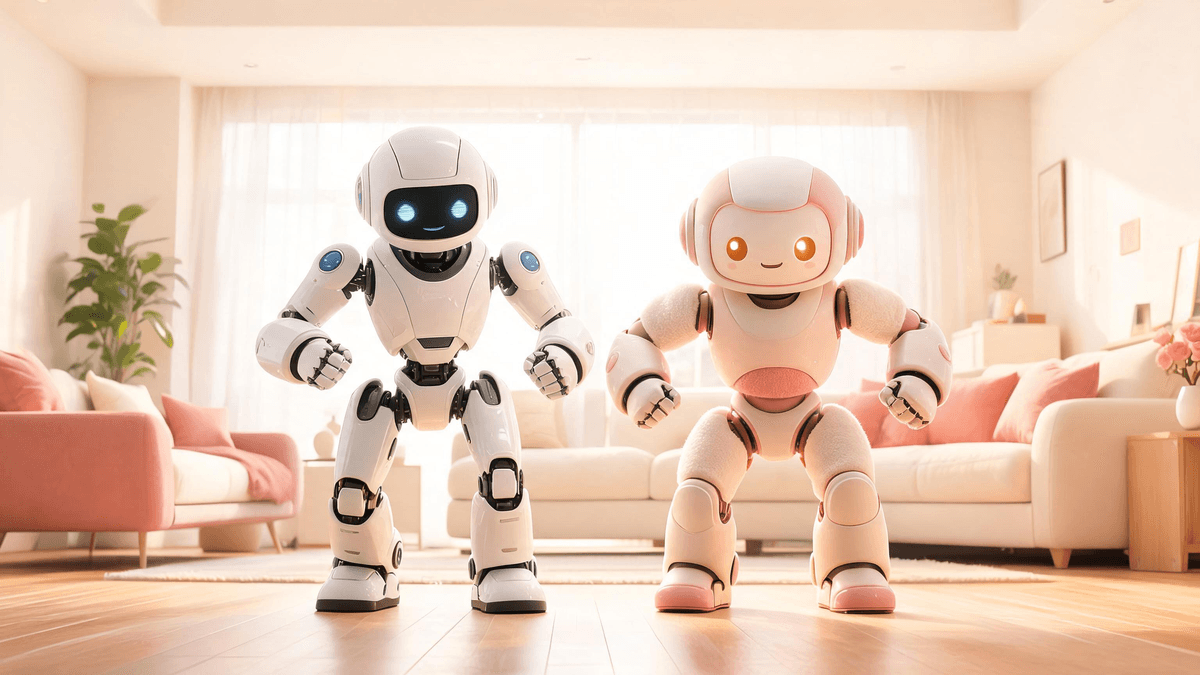
Ask most people which company is winning the home-robot race and they'll say Tesla. Ask which home robot you can actually order today and the answer is not Tesla. That gap — between mindshare and shipping — is the most useful lens on this whole race, so here's where it really stands in 2026.
 ▶Best Home Robots 2026: What You Can Actually Buy
Watch the ranking this piece draws on — every claim sourced.
The one you can order: 1X NEO
1X's NEO is, right now, the only general-purpose home humanoid an ordinary person can order — $20,000 outright or $499/month, with first US home deliveries slated for 2026. It's soft, lightweight, and designed for living rooms rather than factory floors.
The asterisk is fundamental and 1X is unusually open about it: NEO ships with 'basic autonomy,' and for anything it can't do, a 1X employee teleoperates it remotely through a VR headset ('Expert Mode') — seeing inside your home while they do. There are real controls (you approve each session, no-go zones, person-blurring, a light that signals when an operator is live), but early NEO is part robot, part remote intern, and your home is the training data.
The one with the headlines: Tesla Optimus
Tesla's Optimus has the biggest promise in robotics: a Fremont line targeting a million units a year and a $20,000–30,000 price. It also has the widest gap between promise and product. In January 2025 Musk predicted ~10,000 units that year; in January 2026 he conceded zero were doing useful work. Production on the converted Fremont line was slated to start only in late July/August 2026, and Tesla's own projection for commercial sales is roughly late 2027.
So Optimus is a manufacturing thesis, not a purchase — potentially the most important one in the category, but you can't buy it, and nothing has been independently verified doing real work. We put the two side by side in Optimus vs NEO.
The challengers worth watching
The race isn't two horses. Weave Robotics' Isaac 1 undercut NEO by more than half at $7,999, betting that most people's 'home robot' dream is really a laundry-and-tidying dream — deliveries start in California in fall 2026 (NEO vs Isaac 1). Sunday Robotics' Memo is the most credible chore-first robot on paper, trained on real household demonstrations, with a late-2026 beta (NEO vs Memo). And Unitree's G1 already ships at ~$16,000 — but it's a developer platform with no home autonomy, a different thing entirely (G1 vs NEO).
Who's actually winning
Depends what 'winning' means. On mindshare and manufacturing ambition, Tesla. On the only metric that matters to a buyer this year — can I get one — 1X leads, with Weave the value challenger and Sunday the dark horse. The honest scoreboard for 2026 home robots is: two you can pre-order, one beta, one developer kit, and one very loud promise.
Everyone in this race leans on teleoperation to fill the autonomy gap today, so judge them in a year by one number: how many real homes actually have one doing real work. Track it live on our best home robots ranking and the Humanoid Robot Tracker.
Next steps
Related reading
The Robots You Can Actually Buy in 2026 — and the Ones That Are Just Promises
Which home, companion, and humanoid robots can you really order in 2026 — and which are still demos? An honest, price-by-price rundown that separates shipping products from press releases.
When Your AI Companion Gets a Body: The Rise of Companion Robots
The AI companion in your phone is starting to grow a body. What companion robots can actually do in 2026, what they cost, and how close the sci-fi promise really is.
From Apps to Androids: The Future of Embodied AI Companions
Today's AI companion lives in your phone. Tomorrow's may have a human-like voice, years of memory, and a body. Where embodied companionship is heading.